Classification
| # of variables | # of modes | # of jumps |
|---|---|---|
| 4 | 6,9 | 10,18 |
| Type | Continuous dynamics | Guards & Invariants | Resets |
|---|---|---|---|
| hybrid | non-linear polynomial | linear polynomial | identity |
Download
| Flow* Strategy I | diabetic_1.model |
| Flow* Strategy II | diabetic_2.model |
Model description
We consider a model of the glycemic control in diabetic patients such that all dynamics are defined by polynomials. The modeling ODE is given by
![\[ \left\{ \begin{array}{lcl} \dot{G} & = & -p_1 \cdot G - X\cdot(G + G_B) + g(t) \\ \dot{X} & = & -p_2\cdot X + p_3\cdot I \\ \dot{I} & = & -n\cdot (I + I_B) + \frac{1}{V_I}\cdot i(t) \end{array} \right. \]](https://ths.rwth-aachen.de/wp-content/ql-cache/quicklatex.com-34e78d549c83e07aa360520e813afc44_l3.png "Rendered by QuickLaTeX.com")
such that  is plasma glucose concentration above the basal value
  and
and  is the plasma insulin concentration above the basal value
  .
.  is the insulin concentration in an interstitial chamber. The constant parameters are given by
  ,
,  ,
,  ,
,  ,
,  ,
,  ,
,  .
.
The influx of glucose  after a meal is modeled as
![\[ g(t) = \left\{ \begin{array}{ll} \frac{t}{60} & t \leq 30 \\ \frac{120-t}{180} & t\in (30,120] \\ 0 & t > 120 \end{array}\right. \]](https://ths.rwth-aachen.de/wp-content/ql-cache/quicklatex.com-620ef0cd469ce996fff0b651b18701d1_l3.png "Rendered by QuickLaTeX.com")
while the insulin control strategies  due to [1] and [2] are given by
![\[ i_1(t) = \left\{ \begin{array}{ll} \frac{25}{3} & G(t) \leq 4 \\ \frac{25}{3} (G(t) -3) & G(t) \in (4,8] \\ \frac{125}{3} & G(t) > 8 \end{array} \right.\] \[ i_2(t) = \left \{ \begin{array}{ll} 1 + \frac{2G(t)}{9} & G(t) < 6 \\ \frac{50}{3} & G(t) > 6 \end{array}\right. \]](https://ths.rwth-aachen.de/wp-content/ql-cache/quicklatex.com-9d30c5e4fb377184deae0a7012e5727c_l3.png "Rendered by QuickLaTeX.com")
respectively.
Reachability settings
We consider the initial condition ![G(0) \in [-2,2]](https://ths.rwth-aachen.de/wp-content/ql-cache/quicklatex.com-47553702150ad6ac909d8feb9aa3c819_l3.png "Rendered by QuickLaTeX.com") ,
,  ,
, ![I(0) \in [-0.1,0.1]](https://ths.rwth-aachen.de/wp-content/ql-cache/quicklatex.com-94c82cb3be311fc7690ee9bcb95c4830_l3.png "Rendered by QuickLaTeX.com") , and the time horizon is given by
, and the time horizon is given by ![[0,360]](https://ths.rwth-aachen.de/wp-content/ql-cache/quicklatex.com-39959996dbc165034803f45033cc9f1f_l3.png "Rendered by QuickLaTeX.com") .
.
Results
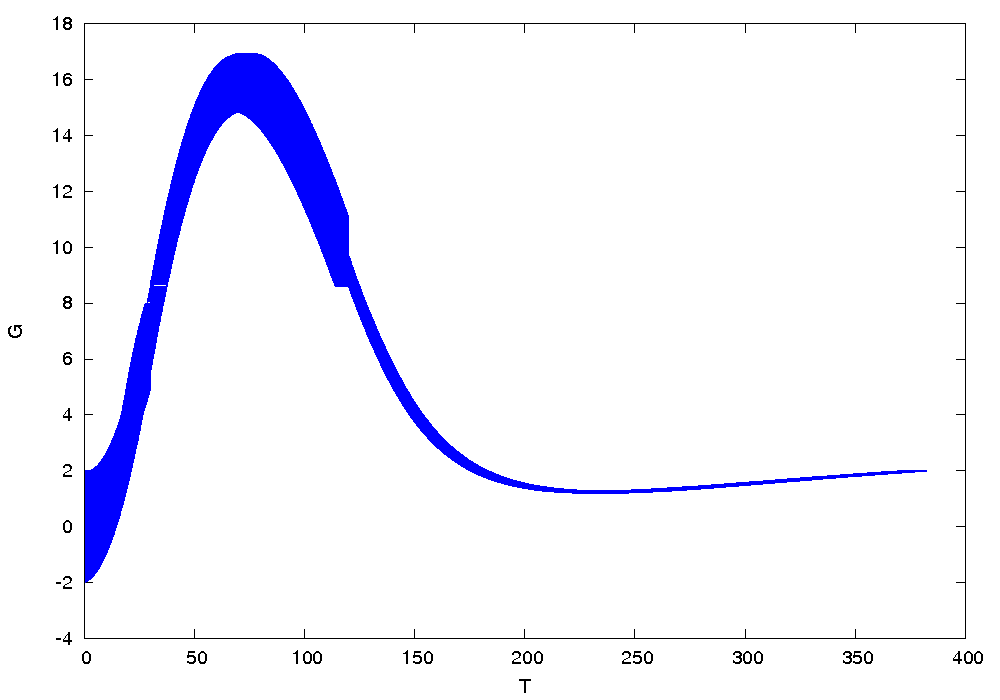
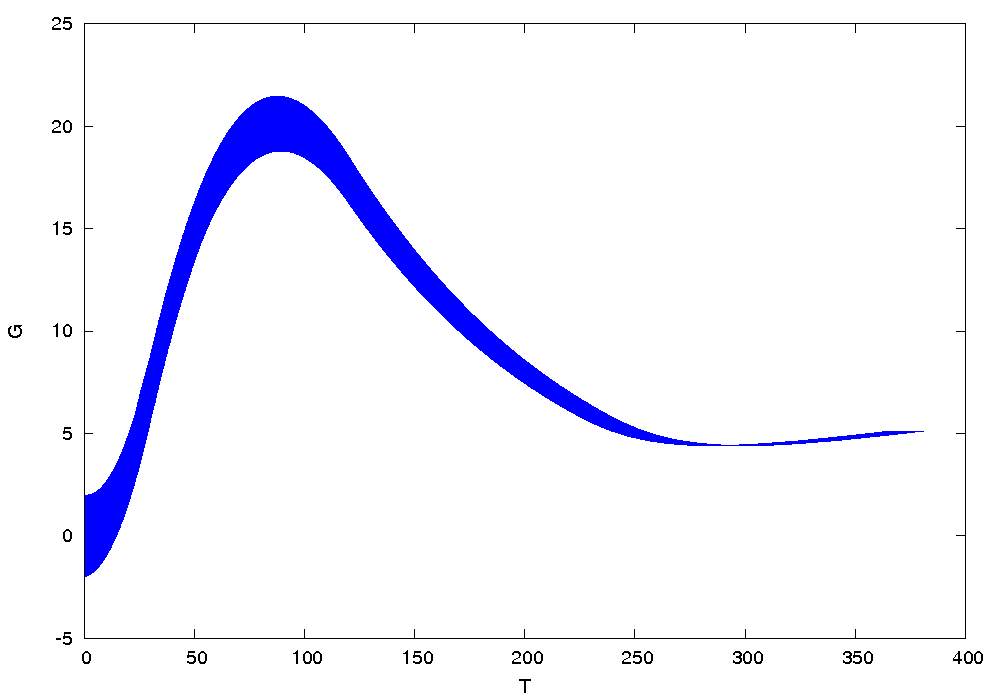
The following figures show an over-approximation computed by Flow* for the first and the second strategies:
References
[1] S. Furler, E. Kraegen, R. Smallwood, D. Chisholm. Blood glucose control by intermittent loop closure in the basal mode: computer simulation studies with a diabetic model. In Diabetes Care, Volume 8, pages 553–561, American Diabetes Association, HighWire Press, 1985. [2] M. Fisher. A semiclosed-loop algorithm for the control of blood glucose levels in diabetics. In IEEE transactions on biomedical engineering, Volume 38(1), pages 57-61, IEEE,1991.